
What makes websites work? 3 Pillars of Effectiveness
14 April 2026
Did you know that as many as 31% of consumers will abandon a company's services if they cannot find its official website? And according to a Hubspot report, websites optimized for SEO (Google) and AEO (Artificial Intelligence) provide the highest return on investment among all digital marketing channels.
The 3 pillars of website effectiveness: people, algorithms, and search engines.
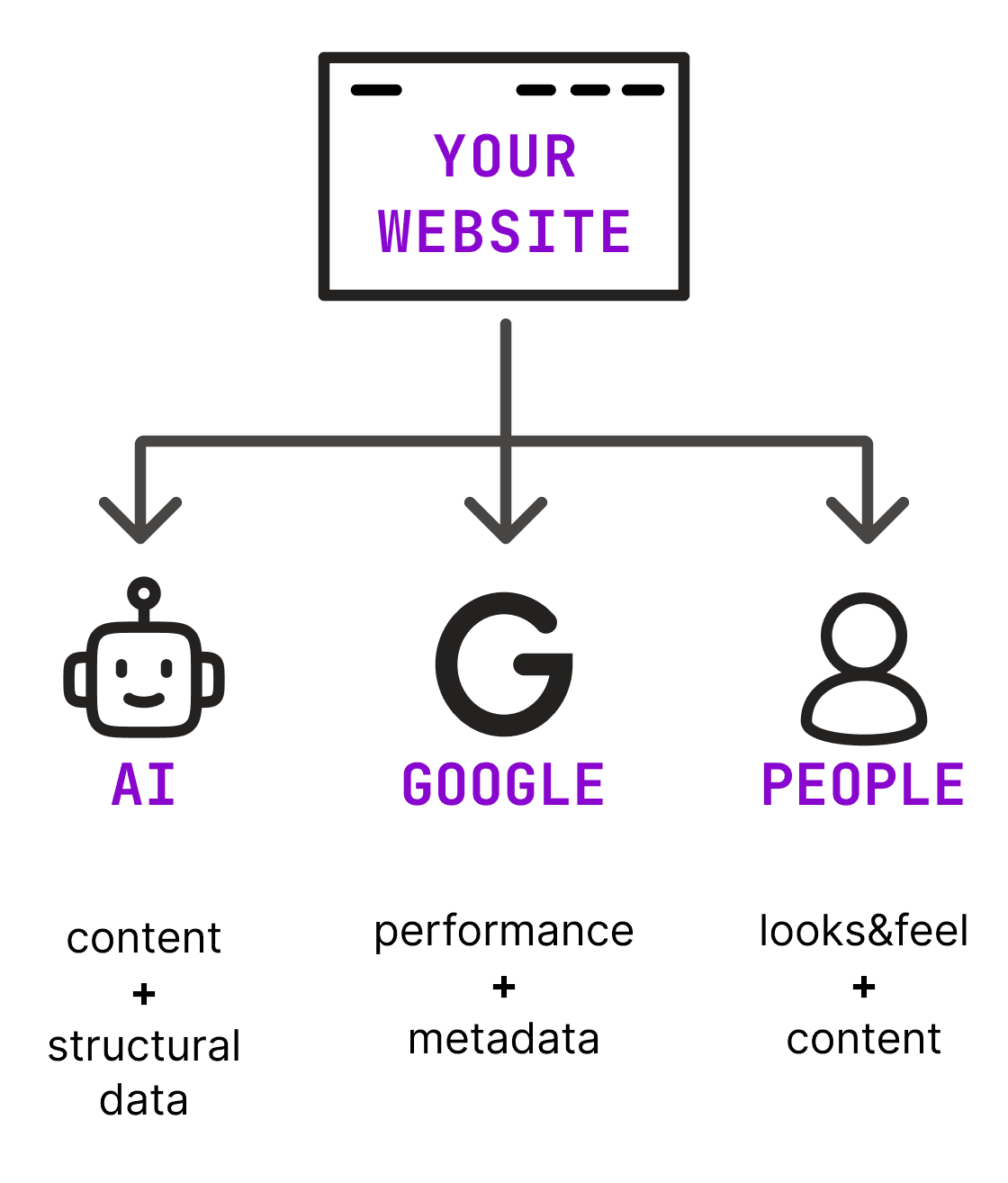
A website has two main jobs: to make it easy for customers to find your business, and to convince them they want to buy from you. For a website to do its job, it must meet three conditions:
- It is understandable to AI agents.
- It is optimized for Google engines.
- It is friendly to human visitors.
In this article, you will learn what these terms mean in practice and how to improve your website to increase its effectiveness.
Why Should You Care?
- 97% of consumers check information online before deciding to use a local business's services. (Source: Market Trend Analysis, Webs.ie 2025)
- Companies with an optimized website grow up to 2 times faster than businesses without one. (Source: SME Competitiveness Outlook 2025)
A company's website is its digital business card, containing all the crucial information for potential customers. It is a tool for building credibility and the best way to be found online. In 2026, having a website is not a business add-on or an extravagant marketing tactic; it is the absolute foundation of running a company. If your business doesn't have a website, from the customers' perspective, it either doesn't exist or is untrustworthy.
Appeal to Humans: Does Your Website Build Trust?
First impressions on the internet happen in a flash. Customers subconsciously judge your professionalism based on how your website looks and works. Therefore, it must look aesthetic, cohesive, and operate smoothly without errors.
The First Impression Effect: A user needs just 0.05 seconds to form an opinion about your website and decide whether to stay. (Source: Behavior & Information Technology, Carleton University)
How to Ensure a Good First Impression?
- Style and Aesthetics: This consists of even spacing, consistent rounding of website elements, and so-called drop shadows. Visual consistency sends a signal to the brain: "There is order here, this company is reliable." Chaos on a website suggests chaos in customer service.
- Typography (Fonts) and Colors: Texts must be appropriately sized, and fonts should be used consistently and matched to the overall style of the website. Colors also matter greatly; the most common mistakes are poor contrast choices (which affect readability) or using too many colors (which gives the user a sense of chaos).
- Navigation and Ease of Use: The website must be intuitive. If a customer has to "search" for contact info or your offer, they will simply leave.
Mobile Customers, Mobile Websites
Over 50% of internet traffic comes from mobile devices, and users are 5 times more likely to leave a site if it is not mobile-friendly. (Source: Google Reports, Think with Google)
Half of your customers browse the internet using mobile phones. If you are targeting individual consumers, this likely applies to 70-80% of your audience. In such a situation, you simply cannot afford to have a website that is not adapted to small screens.
What Should You Pay Attention To?
- Errors: The baseline is eliminating errors that make the site unusable. The most common issue is site elements "spilling" off the screen, making them impossible to read or see. As a result, the entire site might as well not exist, because it cannot be used anyway.
- Website Layout: Small screens require a different approach to navigation, element presentation, and overall layout. Simply "shrinking everything" is not enough, as the result will be illegible and unusable. Modern websites are designed with a "mobile-first" approach—meaning they are designed for mobile devices first, and only then for desktop screens.
- Font and Button Sizes: Fonts and buttons should be scaled down for mobile screens compared to desktops, but you must be careful not to go too far. Fonts should remain legible; in practice, it is best not to reduce them below 13-14px. With buttons, remember that a finger has its own size and precision, so you must provide the user with sufficiently large buttons so they have a chance to actually tap them.
People Buy from People
A whopping 98% of consumers read online reviews of local businesses before making a purchasing decision. (Source: BrightLocal, Local Consumer Review Survey)
The authenticity of your presented materials has a massive impact on building your company's credibility. Try to show photos of your actual work, which allows customers to understand exactly what they can expect from you.
If possible, feature real photos of your team on the website. Authentic faces give your company a genuine personality in the eyes of customers.
Past customer reviews are also incredibly important. Relying on the opinions of others to make decisions is a deeply rooted survival mechanism—use it to your advantage. Always ask customers for a review after completing a project, and then showcase them on your website.
Optimization for AI: Will Robots Recommend Your Company?
The world of search engines is changing right before our eyes. Today, customers increasingly ask assistants like ChatGPT or Google Gemini for services. Your website must be readable to them.
It is predicted that by the end of 2026, traffic from traditional search engines will drop by 25% in favor of AI-generated answers. (Source: Search Market Analysis, Gartner)
How to Make AI Understand Your Website?
- Descriptions and Articles: AI algorithms learn from content. The more substantive information about your services is on your website (e.g., on a blog), the greater the chance that AI will consider you an expert worth recommending.
- FAQ Section (Frequently Asked Questions): This is direct "fuel" for intelligent assistants. By answering specific customer questions, you provide ready-made answers to AI systems.
- Rich Elements (Structured Data): These are hidden tags that tell machines: "this is a price," "this is an address," "this is an opening hour." Thanks to them, your company is correctly understood by the technology of the future.
Websites with extensive FAQ sections and clear data structures have a 40% higher chance of appearing in generative AI search results. (Source: Search Engine Journal)
Visibility in Google: Can Customers Find You?
Even the most beautiful website won't make money if no one visits it. Google is the gateway through which most of your local customers pass.
The top three results on Google capture over 54% of all clicks. (Source: Backlinko, CTR Study)
What is Important to the Google Engine?
- Performance: Website loading speed is a crucial ranking factor today. A slow website is "punished" by Google with lower positions on the results list. You can check your score using a tool provided by Google: PageSpeed Insights. There, you will get a report on how your site performs on mobile phones and computers. Remember, however, that this is a statistic, so the result may vary slightly with each test.
- Bounce Rate Impact: If a page takes longer than 3 seconds to load, the probability that a user will close it (the bounce rate) increases by 32%. (Source: Google PageSpeed Insights Data)
- Technical Optimization (Meta-tags, Robots.txt): These are instructions for the search engine. Without them, Google bots wander aimlessly around your site instead of promoting it. Meta-tags should be added to every subpage, describing its content as accurately as possible so the search engine knows what useful information a user can find there. It is also worth remembering image tags (Open Graph), which is the picture people see when they send a link to your website.
Summary
Websites are the foundation of running a service business. They must be findable—which means being understandable to artificial intelligence and Google—and when someone lands on them, they must convert visitors into buyers.
Pillar | Core Goal | Key Actions |
Human Appeal | Build trust and usability | Improve aesthetics, adopt a mobile-first design, and showcase real reviews. |
AI Optimization | Be recommended by AI assistants | Add substantive content, structured data (Rich Elements), and detailed FAQs. |
Google Visibility | Rank high in search results | Increase page loading speed and optimize technical meta-tags. |
Interested customers are searching; let yourself be found. ;)
Gabriela connects tech with business. She makes sure our code actually drives your revenue.
With an Master in Buissness Managment and a solid tech background, she turns complex AI into clear business results. She manages our 3-day sprints and keeps the whole process completely frictionless for you.
Gabriela Jarzębska
Co-Founder | CEO